
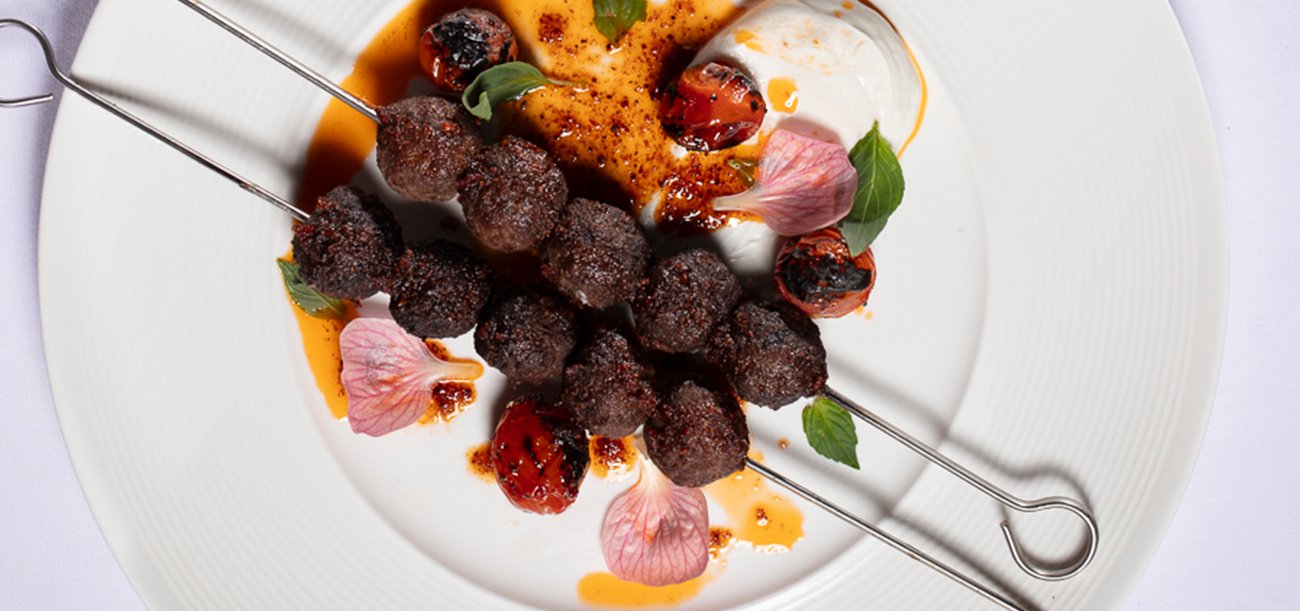
Kabob & Koobideh: A Story of Fire, Poetry, and the Perfect Bite
Welcome to The Translator, where we decode Persian cuisine for the modern table. Today, we explore the most iconic of Persian dishes: kabob. Its story is one of fire, empire, and poetry—and it leads directly to your plate at Perse.
The word arrives on a whisper of smoke. Kabob.
For many, it conjures a single image: skewered meat, grilled to perfection. But the story of kabob is far older, stranger, and more poetic than any single dish. It is a story that begins with the discovery of fire itself and travels through the courts of ancient kings, the couplets of beloved poets, and the bustling bazaars of Tehran, before arriving at our table in Brentwood.
The Etymology: A Word That Traveled the World
Where does the word “kabob” come from? The answer is a journey through millennia and continents.
According to the sources you provided, the word has ancient roots. The Encyclopedia of the Islamic World notes that it derives from the root “kub,” a Semitic root. The American Heritage Dictionary cites a probable East Semitic origin, meaning “to burn,” “char,” or “roast,” in Aramaic and Akkadian. The food historian Gil Marks supports this, noting that the medieval Arabic and Turkish terms were borrowed from the Persian kabob, which likely derives from Aramaic.
This Semitic root appears in the Babylonian Talmud, which instructs that Temple offerings not be kabbaba (burned). These words point back to a prehistoric Proto-Afroasiatic language: kab-, meaning “to burn or roast”.
From these ancient origins, the word traveled. It was popularized in the West by Turks, referring to a range of grilled and broiled meats. It entered English in the late 17th century from Arabic kabāb, partly via the Hindi-Urdu and Persian kabāb, as well as the Turkish kebap.

The word kabob is a linguistic artifact, a testament to
the ancient human discovery that fire transforms food, and that this knowledge spread across continents, carried by the very names we still use today.
The Ancient History: From Hooshang’s Discovery to Royal Feasts
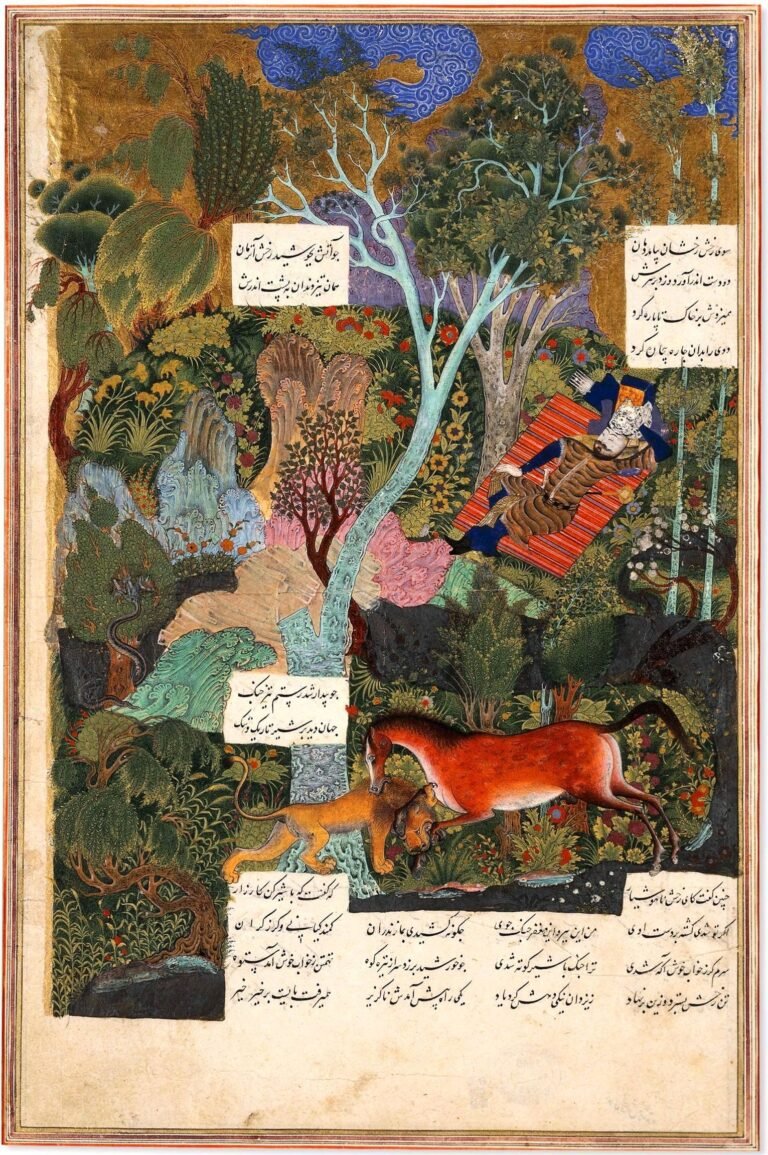
The literature places kabob at the very dawn of human civilization. Archaeological evidence indicates that, with the discovery of fire and the advent of cooking, kabob was the most primitive food among hunter-gatherers. This echoes in Persian mythology: in one version of the story of Hooshang, the mythical king who discovered fire, he immediately roasted his game over the flames.
As civilizations developed, kabob evolved from a simple hunter’s meal into a dish of ceremonial and status significance. The Greek historian Herodotus, writing in the 5th century BCE, noted that wealthy Persians would sacrifice and roast animals like cattle, horses, and camels during festivals, often eating the grilled meat with wine. The middle classes would sacrifice smaller livestock, like sheep
The Shahnameh, the great Persian epic by Ferdowsi, is filled with references to kabob. In the reign of King Jamshid, we read of roasted meat from young cattle, birds, and lambs (Ferdowsi, Khaleghi Motlagh, 1/49). In the Parthian-era poetic text Draxt ī Āsūrīg (The Assyrian Tree), there is a debate between a goat and a date palm, where the goat boasts that its meat, skewered and roasted on a fire made from the palm’s wood, will be used for brēz, the ancient Persian word for kabob.
The Sassanian text Khosrow va Rīdak (Khosrow and the young man) lists roast chicken as one of the most delicious foods, first marinated in olive oil, then skewered and grilled (brishtan).
These texts prove that kabob was not merely food; it was woven into the fabric of Persian identity, from its myths and epics to its courtly feasts and culinary treatises.
From Cookbooks to Poetry
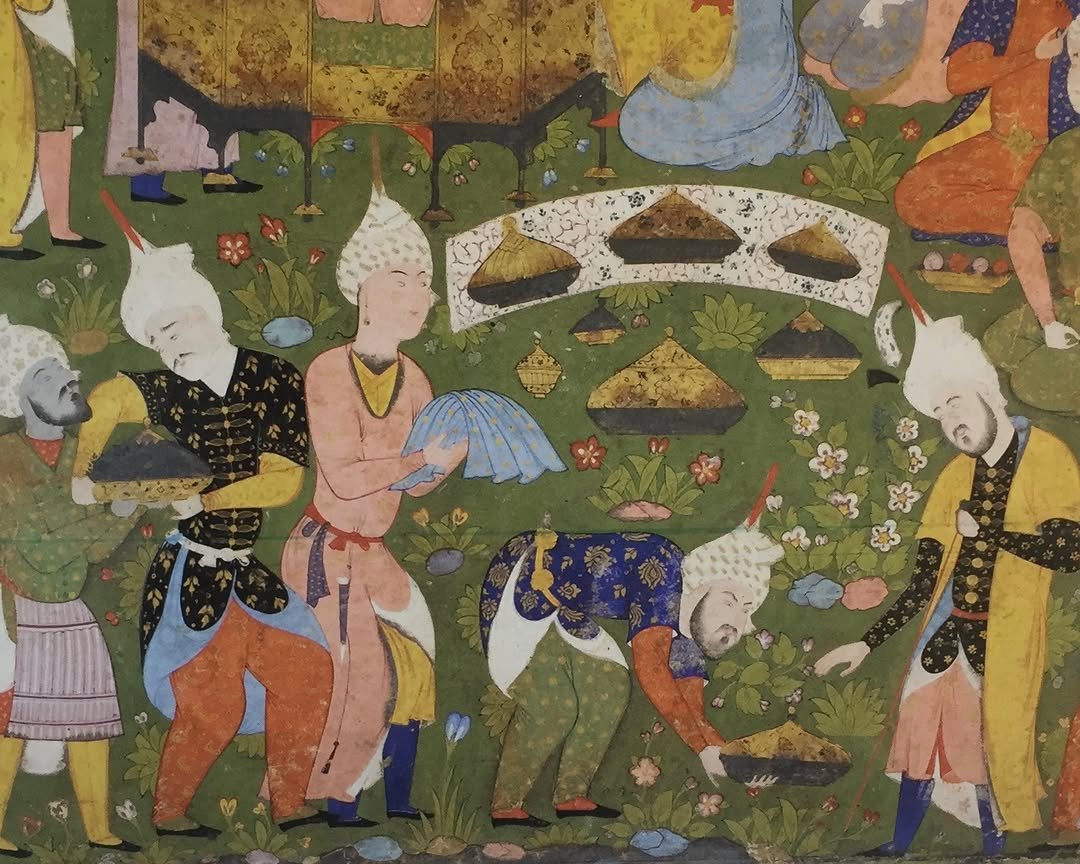
The tradition continued and flourished in the Islamic era. The 10th-century Baghdadi cookbook Kitab al-Tabīkh (The Book of Dishes) by Ibn Sayyar al-Warraq contains descriptions of kabāb as cut-up meat, either fried in a pan or grilled over a fire, a compendium of Mesopotamian, Persian, and Arab culinary heritage.
The word kabob appears throughout Persian poetry. Manouchehri, Khaqani, and Sa’ib all used it, often metaphorically, and frequently paired with wine, the two essential elements of a joyous gathering.
Sa’di wrote:
“او سخن میگوید و دل میبرد / او نمک میریزد و مردم کباب”
S/he speaks and steals hearts away | S/he sprinkles salt, and people become kabob.
Hafez wrote:
“لب و دندانت را حقوق نمک / هست بر جان و سینههای کباب”
Your lips and teeth have a claim of salt | Upon the soul and the kabob-like hearts.
This is not merely poetry but evidence of the kabob’s deep cultural resonance. It was a food so beloved, so central to Persian life, that it became a metaphor for the heart itself, burning, longing, transformed by fire.
Kofta and Koobideh: The Pounded Meat
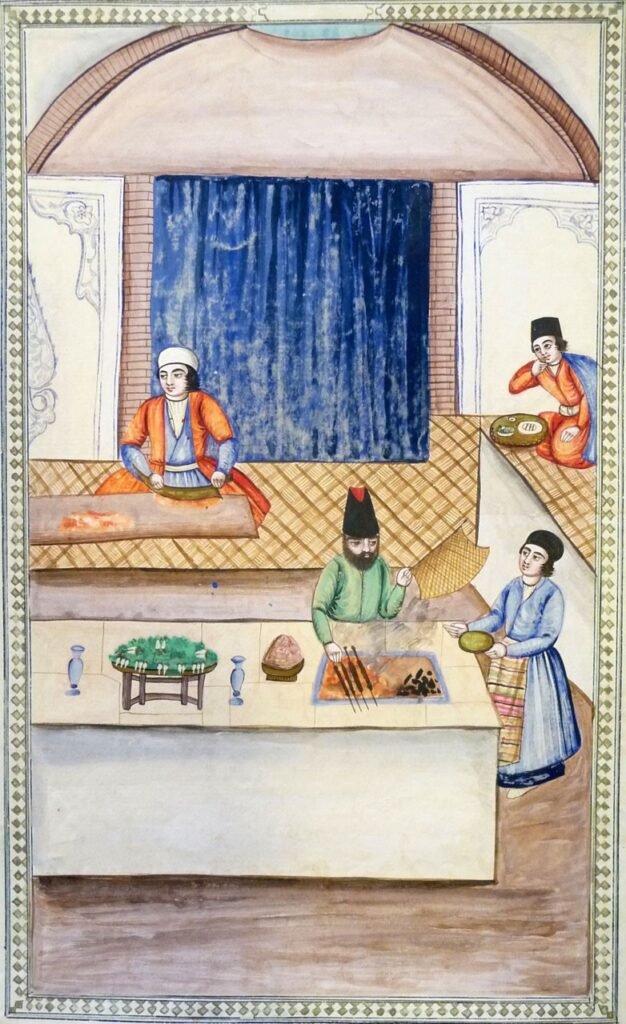
While kabob can refer to various grilled meats, koobideh (کوبیده) has a distinct lineage. The word itself comes from the Persian koftan (کوفتن), meaning “to pound” or “to grind.” This is the same root as kofta, the family of meatball or meatloaf dishes found across South Asia, the Middle East, and beyond.
The earliest known recipes for kofta appear in early Arab cookbooks. These were large ground lamb meatballs, often glazed with a mixture of saffron and egg yolk, a method that spread to the West as “gilding.” From there, kofta traveled to the Indian subcontinent with the Mughal courts, evolving into countless regional variations.
In Iran, this tradition of pounded, seasoned meat evolved into kabob koobideh. Unlike a kofta, which might be spherical and served in a sauce, koobideh is a long, cylindrical kebab, pressed onto a wide skewer and grilled directly over fire.
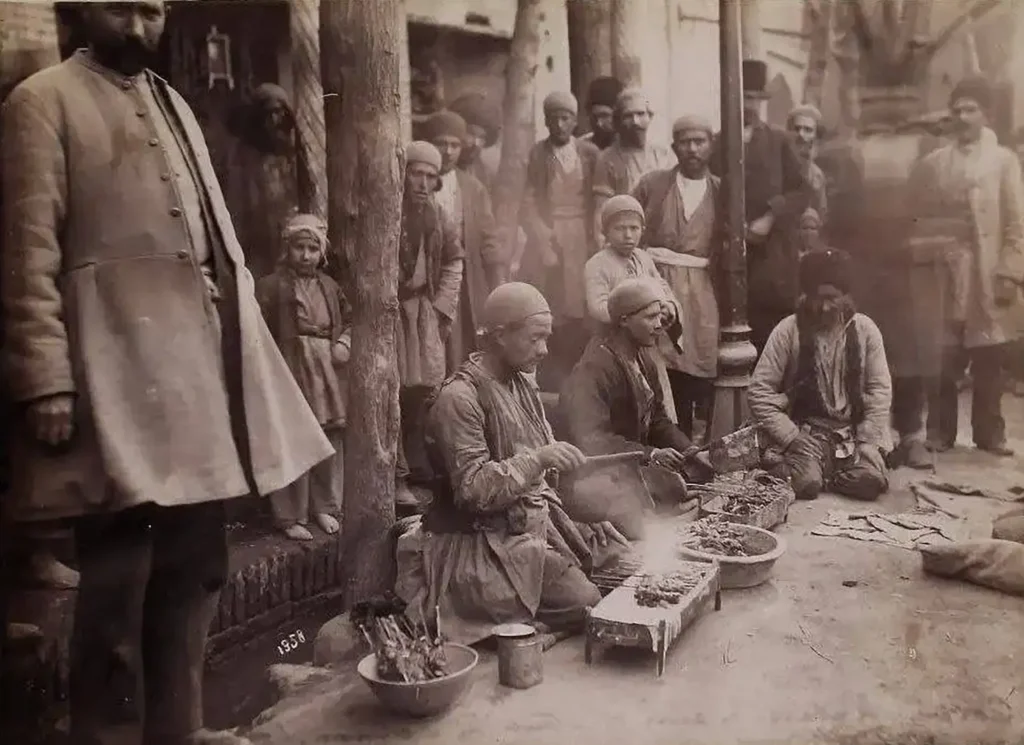
The literature describes the classic Tehrani style: a mixture of ground meat, grated onion, salt, and pepper, sometimes referred to as majāz (or daghi) in the old bazaars. It was often served with sangak bread, whose flat, elongated shape was well suited to wrapping the kebab, its sturdy texture holding up to the meat’s juices (Daryabandari, 2/ 1177- 1178, 1181, 1182; also see Tarikh-e Shahri).
At Perse: Translating Kabob for the Modern Table
At Perse, we honor this millennia-long tradition. But we do not simply replicate it. We translate.
Our approach to kabob begins with the same principle that guided the cooks of ancient Persia: respect for the ingredient and the fire. But we apply it with the precision and craft of a modern kitchen.
Our Koobideh: The Best of Both Worlds
Our koobideh is where tradition meets technique. We studied two lineages:
- The Kofta tradition: The idea of pounded, seasoned meat, crafted with care.
- The Koobideh tradition: The specific Iranian method of preparation, the balance of meat and fat, the grilling over flame.
We took the best of both. The result is a koobideh that is unmistakably Persian in its soul, with the perfect blend of seasoned, juicy meat, but crafted with a tenderness and texture that our guests tell us is unforgettable. It is mentioned again and again in our Google reviews. People don’t just enjoy it; they remember it.
What makes it different?
- The blend: A precise ratio of meat and fat, ground to order, ensuring maximum juiciness.
- The seasoning: Grated onion, salt, pepper, and a touch of our own secret blend, no fillers, no eggs, just pure, intentional flavor.
- The technique: Hand-pressed onto the skewer, grilled over flame until the exterior is kissed with char and the interior remains impossibly tender.
- The ceremony: Served with smoked basmati rice, a fire-roasted tomato, and a sprinkling of sumac, the classic accompaniments that complete the experience.
When you bite into our koobideh, you are tasting:
- The ancient discovery of fire, from Hooshang’s first roast.
- The royal feasts of Persepolis, described by Herodotus.
- The poetry of Hafez and Sa’di, who saw in kabob a metaphor for the heart.
- The bazaar traditions of Tehran, where master kabob is perfected their craft.
- And finally, our own translation: a commitment to honoring that heritage through precision, quality, and an unwavering focus on the perfect bite.
The next time you taste kabob, remember: you are not just eating grilled meat. You are tasting history, poetry, and fire.
Ready to taste the history?
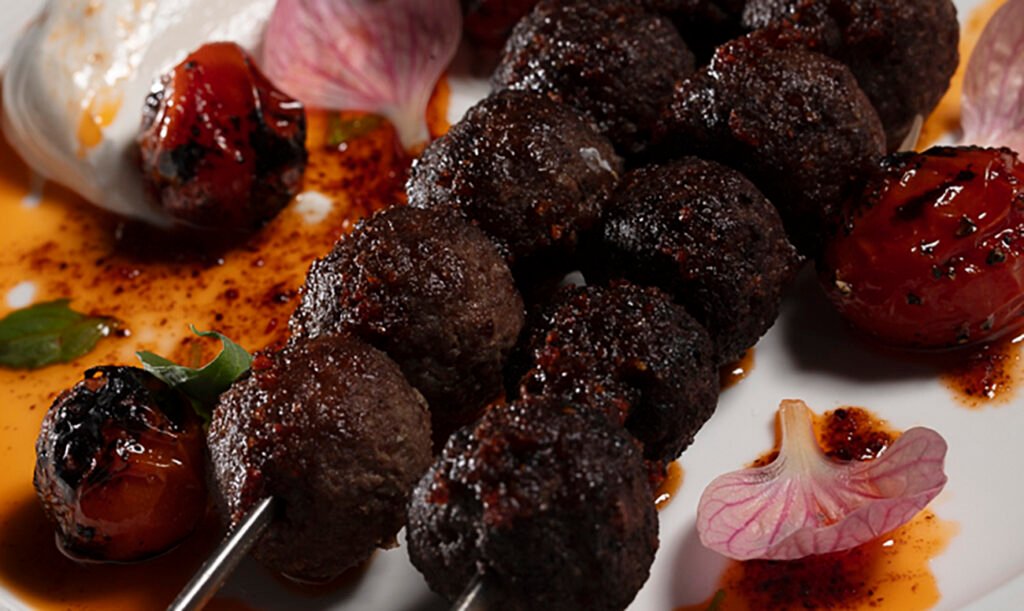
Experience our Koobideh, Torsh Filet Chenjeh, and more. We save you a seat at the table.
Make A Reservation
*Powered by OpenTable
Explore more from The Translator and our Knowledge post:
• Tahdig Isn't Burnt Rice. It's the Crown.
• The Cypress: The Enduring Symbol at the Heart of Perse